



While writing a review of Kosha, I may also mention at the outset that the author and I have been close acquaintances and friends for years following our retirement, having lived close by in the same colony for a long period. In that capacity, I can state with conviction that this novel represents the author’s dream project—a fact vindicated by his own admission in his introduction, “Kahani Ki Kahani,” where he mentions sharing his early writings with his adolescent crush. That initial story left a deep impact on his mind, stayed with him over the years, expanded, and refined, until finally emerging as this finished masterpiece. It was a true pleasure to read, and I am delighted to share my impressions of this classical work.
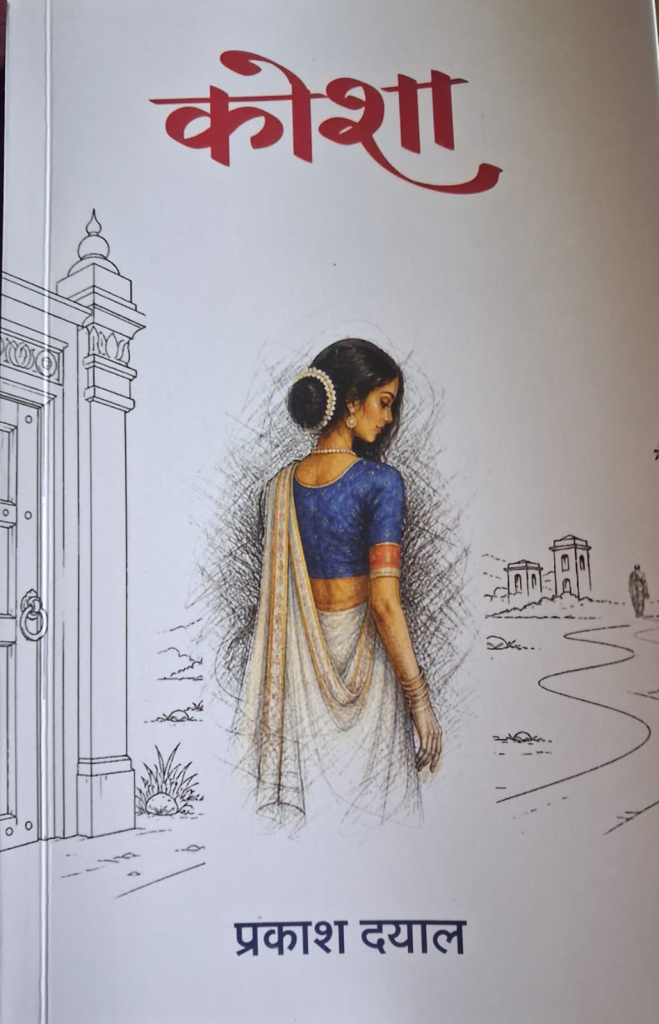
The novel, named after its female protagonist, represents an unending tale of full-throttle worldly indulgence and renunciation between its main characters, Kosha and Sthulabhadra. Among the key supporting figures, Bilas is a close associate and lifelong supporter of Kosha, while Pramath is a fellow disciple (Gurubhai) in the Ashram of Acharya Sri Sambhutvijaya Suri. Here, I cannot resist mentioning another timeless novel, Chitralekha by Bhagwati Charan Verma, which features a similar historical era and central dynamic through its protagonists, Chitralekha and Samant Bijgupt. While Prakash Dayal’s story follows a distinct narrative arc, I perceive compelling and healthy parallels between the two works.
As noted in the foreword by a distinguished academician, the core foundation of this work is derived from a famous tale in the Jain tradition, compiled in Siri-Thulibhadd Fagu by Jin Padma Suri around the 14th century. This celebrated tale redefined traditional spring-romance (Fagu) poetry: rather than merely glorifying seasonal delight and worldly love, it depicts the triumph of self-restraint and spiritual detachment over sensory attraction through the story of Sthulabhadra and Kosha.
The author keeps this traditional narrative firmly in mind to create his magnum opus, diligently organizing the intricate psychological and philosophical conflicts hidden within the ancient story. The plot builds around short, crisp dialogues and narratives, ensuring it never drags under an overdose of preachy discourse. Instead, Dayal depicts the subtle tension vacillating between indulgence and restraint, love and detachment, and worldly pleasure and renunciation.
The plot centres on Sthulabhadra, the elder son of the Mahamatya (Prime Minister) to King Nanda and disciple of Acharya Sri Sambhutvijaya Suri, and Kosha, an extraordinarily accomplished dancer and wealthycourtesan. In a key moment, the Acharya grants his disciples permission to choose a location for their Chaturmas (the four-month monsoon retreat). While many choose austere settings—such as Pramath, who seeks to reside in a cave that doubles as a lion’s den, Sthulabhadra makes an unexpected request: he seeks permission to observe his vows while residing in the house of Kosha. This choice involves no external physical hardships; rather, it is a litmus test of internal desire and attachment—a far more formidable challenge than conquering a forest or mountain.
The narrative then immerses us in Kosha’s world. Exceptionally beautiful, wealthy, and celebrated, she brings joy to others while harbouring a deep emptiness within herself. The author takes painstaking care to craft her environment in rich visual detail—the pleasure chambers, music, adornments, scents, and lamps – contrasting this splendour with her quiet solitude and sorrow.
Conversely, Sthulabhadra’s character is even more complex. Externally, he appears unbridled, wine-intoxicated, and reckless; internally, he is deeply sensitive, wise, and enlightened. As the foreword rightly observes, it is as though he deliberately lets himself fall while carrying an inner torment. Paradoxically, after refusing the King’s offer of the prime ministership following his father’s death out of love for Kosha, he later relinquishes that very love for the calling of an ascetic.
These internal conflicts render both protagonists profoundly human. Kosha recognizes that Sthulabhadra is far deeper than his external reputation suggests, while Sthulabhadra sees beyond Kosha’s status as a courtesan, recognizing an intelligent woman searching for life’s ultimate meaning. Their interactions – fueled by physical attraction, intellectual curiosity, and spiritual inquiry – elevate the narrative beyond a conventional romance.
The novel reaches its sharpest philosophical turn when Sthulabhadra returns to Kosha’s house for Chaturmas as a newly initiated ascetic. For Kosha, his return awakens buried longing; she approaches him through the lens of love and surrender. Sthulabhadra, however, views her through the lens of detachment and restraint. Yet Sthulabhadra’s renunciation is not entirely flawless; it carries a subtle ego regarding the attainment of Moksha (liberation). In his pursuit of self-liberation, he initially risks overlooking Kosha’s emotional reality. Kosha’s reaction to this dynamic transforms her into a symbol of human consciousness seeking truth beyond sensory experience.
Regarding style and execution, I agree with the foreword’s assessment: the storyline is linear, yet the author frequently pauses to explore the psychological depths of his characters. The dialogues do not merely advance the plot; they reveal complex layers of thought. In several instances, the philosophical brilliance of these exchanges feels like a direct medium for the author’s own reflections, while the measured pace of the descriptions builds an immersive atmosphere.
A view emerged in the foreword that Kosha offers neither a definitive conclusion nor a singular doctrine. I view this through the broader lens of Hindu philosophy. The Ashram system and Purushartha framework prescribe Kama (desire) and Artha (wealth) for the householder under the guidance of Dharma, eventually leading to renunciation and Moksha.
Comparing Kosha with two other classics illustrates this enduring literary theme:
In Bhagwati Charan Verma’s Chitralekha (1934), set during the Maurya era, the courtesan Chitralekha and nobleman Bijgupta lead lives of luxury before ultimately renouncing their status out of selfless love to seek a simple, peaceful existence together.
In Hermann Hesse’s Siddhartha (1922), the title character experiences luxury and romance with the courtesan Kamala, only to leave it all behind for a quiet life by the river in search of enlightenment.
Ultimately, Kosha addresses the universal human dilemma between desire and detachment, indulgence and renunciation. That different characters find unique paths through this conflict reflects an enduring truth of human existence and literature. I convey my warmest best wishes for the great success of Shri Prakash Dayal’s work and hope it reaches the wide, appreciative audience it deserves.
Note: The book is readily available on sale on Amazon
3,146 total views, 12 views today




No Comments
Leave a comment Cancel