



Misconception and Misunderstandings – 4
(C) History and Symbols
(1) Mythology vs. Itihasa (History):
During the British Raj, the western historians and Indologists dismissed Indian texts like Vedas, Puranas, Dharmashastras, and epics – the Ramayana and the Mahabharata purely as “mythology” or fictional tales. Many colonial era scholars, administrators and missionaries perhaps consciously used condescending, dismissive, and explicitly derogatory terms to describe the ancient Sanskrit literature. Driven by Eurocentric biases and a purported will to justify British rule, they often dismissed ancient Indian texts as irrational, primitive, or morally inferior. The author can cite umpteen documented instances where colonial Western historians and scholars such as Max Müller and James Mill, or administrator William Jones and Thomas B. Macaulay, quoted or translated ancient Sanskrit texts with notable errors or misinterpretations, either driven by the lack of deep cultural understanding, literal over-simplification of terms/texts, or just due to Eurocentric biases. This is not the subject of this essay but such a reference is essential in the context of current subject under discussion.
Actually, the traditional understanding of world civilizational history, chiefly owing to colonial era dominant Western historians and European scholars, has largely revolved around the Greco-Roman heritage as the chief foundation of authentic civilisation. Ancient Greece was constantly celebrated as the cradle of philosophy, rational inquiry, democracy, literature and scientific thought, while Rome was acknowledged for its contributions to law, governance, military organisation, engineering and institutional administration. In doing so, they almost completely missed or deliberately ignored well developed, very rich and old civilizations of the oriental world. This perspective gradually developed into a historical narrative in which classical Greece and Rome, followed by medieval Christendom and the Renaissance in West, were presented as successive stages in the making of true modern world civilisation. This briefly explains why the history of Indian (Hindu) civilization is still downplayed by the Western countries predominantly treating it mythology.
However, this conventional world view has increasingly been questioned by many modern historians, in India and elsewhere, who point out that the history of human civilisation was neither exclusively Western nor a linear progression originating in Greece and culminating in Europe. It is therefore important to distinguish between the evolution of Western civilisation and the broader history of world civilisation. In fact, the Greek knowledge itself involved substantial contributions from Indian and other Eastern traditions, and Byzantines, Persian, Arabs as well. Therefore, the traditional Greco-Roman-centred civilizational narratives need to be viewed in the wider context of parallel and interconnected civilisations of ancient India, China, Egypt, Mesopotamia, Persia, and so on, because Greco-Roman civilisation-centric interpretation does not adequately capture the antiquity, diversity and independent intellectual achievements of the great civilisations like India and China. Quite obviously, the West can no longer dismiss or ignore ancient Indian civilizational and cultural heritages and contributions recorded in various texts and other sources simply as mythology.
Western historians and Indologists, particularly from the eighteenth and nineteenth centuries onwards, approached the civilizational history of the Indian subcontinent largely through limited philological studies, archaeological discoveries, comparative religion and colonial-era historical frameworks. Subsequently, they picked up threads from the discovery of the Indus Valley Civilisation at Harappa and Mohenjo-daro in the 1920s suggesting the existence of an advanced urban civilisation dating back to the third millennium BCE. They largely interpreted this as pre-Vedic civilisation from the later Vedic period, generally placing the composition of the Rigveda around 1500 BCE and linking the emergence of Vedic culture with Indo-Aryan migrations into the subcontinent. In a nutshell, this is how the existing familiar historical sequence of Indus Valley, Vedic, post-Vedic and later classical Indian civilisation have been accounted for by the Western historians and scholars as the ancient history of Indian sub-continent.
From the perspective of Sanatana Dharma and traditional Indian historians, the aforesaid chronological order raises many vital yet unresolved questions (by Western proponents) about the relationship between the Harappan civilisation and the original Vedic tradition, more so because the latter represents a vast body of philosophical, spiritual, civilizational and cultural knowledge whose precise origins and chronology remain subject of scholarly discussion. The nineteenth-century Aryan Invasion Theory, with its racial and colonial interpretations, too, has been found flawed increasingly giving way to the more questions and scepticism by modern scholars and thinkers. Naturally, Indus Valley remnants and Aryan arrival theory in north-western Indian subcontinent at some point of time are not sufficed to explain the culturally rich civilization of the Indian subcontinent with a vast expanse of geographical spread. The civilizational and cultural attributes and evidences as available in various forms at various places must be accounted for to determine the civilization and its age.
The contemporary scholarship inter alia demands the need to examine indigenous textual traditions i.e., the Vedas, Upanishads, Puranas, Epics (Ramayana and Mahabharata), Shastras and Smritis, alongside archaeological, lithographic account and inscriptions, Jain and Buddhist literature, and other linguistic and genetic evidences. The central issue is when and how the distinctive civilizational ethos of Sanatana Dharma evolved, assimilating diverse traditions with remarkable continuity across millennia. While working on Indian history, the Western historians of colonial age treated the genealogies of kings, particularly the Suryavansha (Solar Dynasty) descending from Ikshvaku and the Chandravansha (Lunar Dynasty) were generally treated as repositories of mythological dynastic memory rather than established historical chronologies. Though few dynasties of subsequent origin such as the Shishunaga (c.413–345 BCE), the Nanda (c.345-322 BCE), etc., were given some credence, the Indian history in true sense has been reckoned by them from Mauryan Empire onwards. Quite obviously, the erstwhile approach of Western historians and Indologists of the colonial age does not truly represent the ancient history or Itihasa of the Indian (largely Hindu Sanatana) civilization. Unfortunately, the legacy Indian regimes after independence too patronised colonial line for several decades.
It may be worth mentioning here that James Mill (1773–1836), a Scottish historian and political theorist had written a monumental work “The History of British India” based on the contemporary colonial age knowledge accounting Indian history on the basis of the Hindu, Muslim and British dominance in the subcontinent. Many subsequent Western historians formed this book as basis while deriving some of their own inferences in their historical studies. Although flawed and insufficient in many ways, the broad periodization of the chronological Indian history based on the Western synergised and hybridized view, is briefly summarized as under:
Pre-history and Indus Valley Civilisation (until 1750 BCE); Vedic Period (1750-500 BCE); Second Urbanisation (600-200 BCE); Classical/Ancient Period (200 BCE – 1,200 CE); Medieval Period (1,200 CE – 1,500 CE); Early Modern Period (1,500 CE – 1,850 CE); Modern period (British Raj and post- independence 1850 CE onwards).
As against the Western view, the Indian traditional historians and scholars have approached the ancient Indian texts i.e. Vedas, Puranas, Ramayana and Mahabharata, etc., not simply as religious or mythological compositions, but as interconnected repositories of India’s civilizational memory, historical traditions, genealogies, mundane social, and philosophical knowledge. The concept of Itihasa-Purana occupies a distinctive place in this understanding, preserving accounts of ancient rulers, sages, dynasties, kingdoms, migrations, conflicts and cultural developments. The Solar dynasty (Suryavansha), beginning with Ikshvaku and culminating in the celebrated lineage of King Sri Ramachandra, and the Lunar (Chandravansha), associated with Pururavas, the Kurus, Pandavas and Shree Krishna, are regarded as important strands of an interconnected historical tradition. Scholars such as R.C. Majumdar, H.C. Raychaudhuri and many other Indian historians have used Puranic genealogies and epic traditions in reconstructing the ancient Indian political and dynastic history. The traditional Indian approach has been its understanding of chronology through the larger framework of cosmic time, encompassing the four Yugas—Satya, Treta, Dvapara and Kali—along with Manvantaras and successive dynastic eras. In contrast, most Western historians had considered Ramayana Age and Mahabharata Period, and historical accounts prior to it as part of Indian mythology.
Owing to certain gaps and criteria adopted, there are indeed differing interpretations too regarding the precise dates of the Ramayana age, Mahabharata period and individual dynasties. Nonetheless, based on detailed study of the Vedic corpus, Puranas, Itihasa texts (Epics), Buddhist and Jain sources, Sanskrit and Prakrit poetic literature, regional chronicles, genealogical succession, astronomical references, planetary configurations, lithographic accounts and inscriptions, Vamsavalis, monastic chronicles, traditional legends to establish the antiquity and continuity of Indian civilisation. The estimated Indian traditional chronology starting from the Vedic period to the Mahabharata period along with some major events is briefly as follows:
The Pre-Vedic Period (until 14,500 BCE); The Vedic Period (14,500 – 10,500 BCE) – The Great Flood of Manu’s Kingdom in 11,200 BCE; The Post-Vedic Period (10,500 – 6,777 BCE); The 28th Treta Yuga (6,777 – 5,577 BCE) – The Ramayana Era 5,677 – 5,577 Sri Ramchandra’s Birth 3rd February 5674 BCE; The 28th Dvapara Yuga (5577 – 3176 BCE) – Mahabharata War 3,162 BCE; The 28th Kali Yuga (3,176 BCE onwards).
Due to differing interpretations even among traditional Indian scholars regarding the precise dates of the Ramayana, Mahabharata and individual dynasties, it remains a subject of debate if the estimated chronologies should be treated as established historical facts. Nevertheless, the central proposition is that India’s civilizational and cultural roots extend far beyond the conventional dates assigned to the Vedic period in the Western historiography, and that its ancient Indian texts deserve to be examined as serious historical and civilizational sources rather than dismissed wholesale as mythology. As we know, among issues between the Western and traditional Indian historians, the former treat Ramayana and Mahabharata as mythological texts while the latter interpret these epics as chronicles of historical memories, subsequently enriched through generations of oral transmission, literary composition and possible interpolation.
Actually, some colonial historians and Indologists initially approached Sanskrit texts with a genuine intellectual curiosity and orientalist fascination, which led to translation of the Vedas, Upanishads, Bhagavad Gita, Dharmashastras and other Sanskrit literature acknowledging India’s remarkable antiquity and philosophical achievements. However, with the emergence of Utilitarian and imperialist historiography, particularly through James Mill’s History of British India (1817), a more dismissive interpretation increasingly gained influence classifying Puranic genealogies, Itihasas and other chronologies as mythology rather than credible historical records. Consequently, the tendency to depict the Indus Valley Civilisation as the chief archaeological starting point for explaining India’s ancient civilizational evolution became a dominant limiting factor of the Western historiography, giving inadequate attention or consciously ignoring the independent antiquity, diversity and parallel development of cultural traditions across the wider subcontinent, especially the ancient Dravidian cultural and linguistic traditions of South India, the distinctive tribal and indigenous cultures of the North-East as also the diverse Chalcolithic and other archaeological cultures of western and central India to build an inclusive civilizational narrative.
A more comprehensive understanding of the Indian civilisational history must therefore recognise multiple regional centres of cultural development, an approach rightly adopted by Indian traditional historians and Oriental scholars with a view to making distinction between mythology and legendary history. Of course, the Puranas and epics often combine historical memories, dynastic genealogies and accounts of real or traditionally remembered personalities along with supernatural elements, extraordinary events and divine interventions with Adbhut Rasa (wonderment). Such interpolations and embellishments may have become so interwoven with the original narrative passing through generations that the historical personality itself gets overshadowed, leading modern readers to believe or classify the entire account as fictional mythology. For illustration’s sake, the life and legacy of King Ramachandra cannot be judged merely through the lenses of supernatural elements in the Ramayana; instead, it is also significant to consider his widespread cultural memory along with temples, traditions, place names and landmarks associated with his story across South-East Asia, including Indonesia, Thailand, Cambodia, and other regions as well.
While such evidences do not suo moto establish every event or chronological detail as historical fact, but neither does it justify dismissing the underlying personality and historical memory as fictional. A rational approach would be an endeavour to differentiate the possible historical core from its literary, theological and cultural embellishments, evaluating it through independent textual, archaeological, epigraphic and comparative evidence. The crux of the point is that presence of the extraordinary in an ancient narrative cannot automatically invalidate the possibility of an underlying historical reality. From this perspective, when the geographical trails associated with Sri Ramachandra such as Ayodhya, Chitrakoot, Panchavati, Kishkindha and Rameswaram in India, along with the widespread Ramayana traditions, monuments and regional narratives of Thailand, Cambodia, Indonesia, Laos etc. are taken together, it would be well-nigh impossible to deny existence of Sri Ramchandra and Ramayana age. Similarly, the Mahabharata with its characters and events too has somewhat similar extensive geographical and cultural footprint associated with Hastinapur, Kurukshetra, Indraprastha, Dwarka, Panchala, Mathura and numerous other locations beyond the subcontinent.
This author is inclined to go with traditional Indian historians’ account and timeline of the Indian history for the following reasons:
1. Many colonial era Western historians and Indologists did not have clear understanding of Sanskrit terminology, its terms and connotations. Instead of counting on their errors, suffice to say here that many Sanskrit terms do not have exact concurrent Roman-Greco or modern English word meaning yet they have been conveniently adopted so. For instance, Dharma in Sanskrit broadly implies righteous duty and action while it has been universally equated with religion of the Abrahamic faiths so much so that even majority modern age Indians (Hindus) have started taking them as synonyms. Moreover, owing to racial bias and superiority complex, perhaps most of them did not care to look beyond flawed Aryan Invasion Theory and archaeological remains of Indus Vally Civilization to have a holistic view on histography of the Indian subcontinent. So, the history of Sanatana civilisation deserves to be investigated on its own civilizational foundations, rather than confined to chronological assumptions inherited from colonial historiography.
2. According to Western historical and archaeological consensus, the history of Greek civilization in a rather small South European geographical stretch roughly dates back to 9,000 years dividing it to Early Agrarian Settlements (say c.7,000 – 3,200 BCE), the Early Aegean Bronze Age (c.3,200 – 2,000 BCE), Palatial Civilizations & Classical Era (c.2,000 – 323 BCE). The very Western scholars also traced remains of the earliest agricultural villages in norther regions of Indian subcontinent of 8th – 7th millennium BCE at Mehrgarh (now Balochistan), Ghaggar-Hakra Basin (Haryana), and Middle Ganges Valley (Lahuradewa, Uttar Pradesh). Such accounts, and many more archaeological sites later discovered in South India, Northeast and Western reason vindicate the presence of largely agrarian set ups in various parts of the subcontinent. While it is a settled belief of many Indian traditional historians and scholars that the Vedic and post-Vedic periods were characterized by predominantly well-developed agrarian societies, the well documented account of practices such as continuous use of agricultural produce, worship of natural deities through yajna/fire ritual for own and family’s safety and wellbeing, reverence to cow, etc. in Vedas and Upanishads only validate and vindicate these beliefs. These facts and figures only add to credence strengthening the Indian indigenous view of the vintage and legacy of the ancient Indian civilization.
3. Geographical continuity associated with legendary dynasties, kings, rishis, etc., and their trail /footprints beyond Indian subcontinent too, deserves serious historical cognizance and consideration. The persistence of place names, local traditions, archaeological remains and cultural memories cannot simply be brushed aside. Historical verification must remain evidence-based. Archaeology, inscriptions, palaeography, textual analysis and scientific dating should not be brushed aside to distinguish verifiable facts from traditional accounts and later accretions.
4. The reconstruction of ancient Indian civilisation through the lenses of conventional Western historiography and intellectual framework has often accorded disproportionate importance to the Greco-Roman historical framework. The absence of conclusive archaeological verification of every episode in genealogy or events in Puranas or an ancient epic is not proof in itself that its principal characters, underlying events or civilizational memories are fictional (Mythological).
4. Supernatural narratives do not necessarily negate historical foundations. The Adbhut Rasa, divine interventions and extraordinary descriptions may reflect theological interpretation, poetic imagination and centuries of oral and literary embellishment. It appears that the abundant use of Adbhut Rasa in Sanskrit poetry and drama as also the poetic exaggeration of narratives made sceptics and biased Western historians and Indologists to believe the historical legends into historico-mythological legends.
In the light of foregoing, it needs no emphasis that India’s ancient past requires a balanced reconstruction with an open-minded synthesis of traditional textual sources, archaeology, inscriptions, linguistics synergized with scientific evidence—avoiding both unquestioning acceptance and preconceived dismissal. To that extent, Indian traditional scholarship views the ancient Indian texts as interconnected repositories of civilizational memory, genealogies, philosophical thought and historical traditions, encompassing the Solar and Lunar dynasties and the larger chronology of Sanatana Dharma, providing more credence to reconstructed chronology and history despite gaps.
(2) Conversion and Exclusivism:
Undoubtedly, the issue of religious conversion (proselytization) and exclusivism highlights one of the sharpest divides between Western Abrahamic paradigms and the Sanatana Dharmic worldview. On one hand, the interested religious and political groups purportedly indulge in anti-Hinduism propaganda at home and abroad citing the concept of Hindutva as aggressive and harmful for others; on the other hand, there are misconceptions such as one must be born a Hindu to be a Hindu or even that Hinduism actively proselytizes like missionary faiths. Reality is that Sanatana Dharma has always served as an eternal way of life, an open-ended and experiential search for Truth accommodating from all sources rather than a sort of rigid membership club.
As such controversies or issues (about conversion and exclusivism) arise world over very often in the context of Abrahamic religions – Christianity and Islam, it may be relevant to briefly examine their creedal position and practice on ground (for a reference) vis-à-vis similar position in contemporary Hinduism, without indulging into more controversial issues relating to the creedal religions.
Christianity: Historically, Christianity has professed an exclusivist theological position, particularly in its traditional interpretations, holding that salvation is ultimately through Jesus Christ. In this context, the Biblical assertion (John 14:6), “I am the way, and the truth, and the life; no one comes to the Father except through me” has been central to this conceptual position. Consequently, evangelisation and conversion have remained an integral part of the Christian religious history. While present age Christian denominations considerably differ in their approach to other faiths, and some contemporary churches emphasise religious freedom too, dialogue and respect along with unquestionable belief in the unique salvific role of Christ remains fundamental to most major traditions. Historically, coercion too played a significant role as politics synergised with an aggressive missionary activity, with active support of political power, in the spread of Christianity in various parts of globe.
Islam: Islam depicts an equally strong, and rather more categorical, claim of religious exclusivity. It regards itself as the final and complete revelation of God’s will, with Prophet Muhammad as the last messenger and the Quran as the final divine scripture. Dawah (invitation to Islam) is an important religious obligation by Momin (faithful), and conversion to Islam is actively encouraged. Although the Quran (2:256) explicitly states, “There is no compulsion in religion”, making voluntary acceptance an important principle. Nevertheless, the classical Islamic jurisprudence has traditionally treated apostasy (renunciation of Islam) as a serious offence and conversion to faith (Dawah) as a sacred duty, with significant variations in interpretation and application across schools and contemporary Muslim societies. Further, while Islam formally recognises certain rights of other religious communities, its theological claim to finality and the traditional restrictions concerning apostasy reflect a distinctly exclusivist framework. Unlike present age Christianity, coercion is still resorted to by political and religious groups indulged in proselytization in various parts.
Notwithstanding dogmatic principles and creedal position, neither Christianity nor Islam is entirely uniform in its contemporary interpretation of religious exclusivism, conversion and freedom of conscience. Such impact of proselytization and exclusivism is more pronounced and visible in heterogenous societies of South Asia, such as India and Bangladesh. While significant conversion out of Christianity take place towards Atheism, Agnosticism and Islam; however, similar conversion out of Islam is minimum because it often carries considerable social, familial stigma and, in some countries, legal consequences. Apostasy is punishable under the laws of certain Muslim-majority countries, while social ostracism, threats and family pressure discourage more people from openly declaring a change of faith. Thus, the freedom to enter Islam is generally more readily available than the freedom to leave it—a significant gap between the professed principle of religious choice and its practical application on ground.
Hinduism (Sanatana Dharma): Since inception, Hinduism has a fundamentally different approach to conversion and religious exclusivism compared to the traditional Abrahamic framework. Hinduism does not rest upon the premise that there is only one prophet, one final revelation, one scripture or one exclusive path to salvation. With its age-old philosophical concepts of Vasudhaiva Kutumbkam (The whole world is one family), Sarva Dharma Sambhav (All faiths lead to the same destination), and Sarve Bhavantu Sukhinah (Let everyone live happily), it accommodates within multiple paths to spiritual realisation, such as Jnana Yoga, Bhakti Yoga, Karma Yoga and Raja Yoga, among others. Besides, the Rigveda’s dictum (1.164.46), “Ekam Sat Vipra Bahudha Vadanti”— Truth is One, the wise describe it in different ways — captures Sanatana Dharma’s pluralistic essence and outlook. The Bhagavad Gita (4.11) similarly states that people approach the Divine through different paths, and that the Divine responds accordingly.
Consequently, Hinduism has no universal theological mandate to convert people of other faiths, nor does it generally regard adherence to another religion as apostasy or a rejection of an exclusive divine covenant. So also, for conversion to Hinduism, there is no universally prescribed conversion ceremony nor there is a prohibition against accepting people from other faiths. Historically, Hinduism has never been a proselytising tradition. As Indian subcontinent had a history of foreign (mostly Islamic) invasions for centuries leading to massive coercion and conversion, some Hindu sects such as Arya Samaj introduced Shuddhi (purification/re-admission), enabling people who had left Hinduism, as well as newcomers, to embrace it at will. In contemporary India, Ghar Wapsi is a new expression of this approach. Unlike the traditional Abrahamic concept of apostasy, a Hindu adopting Christianity, Islam or any other faith is not regarded as having committed an offence against God; so also, he seldom faces social exclusivism or ostracism. The concept of Hindutva, aggressively used as a tool to malign Hinduism, too has been examined at length by five- and seven judges’ benches of the Supreme Court of India in 1995 and 2016, respectively, and held harmless to the interests of any other community or faith.
Thus, there is a significant asymmetry in traditional religious practice world over. In Islam, conversion into faith is welcomed, whereas conversion out of faith has historically been prohibited or penalised in many interpretations. Christianity actively encourages conversion into the faith through evangelisation: Conversion out of Christianity is generally not a criminal offence or punishable under mainstream Christian doctrine, although some denominations regard apostasy as a grave spiritual rejection, and social or familial pressures may persist. In Hinduism, apart from broad position explained above, certain Hindu sects and organisations may regard their own philosophical or devotional path as superior, and some social practices have sometimes been restrictive. Nevertheless, the broad civilisational ethos of Sanatana Dharma is one of accommodating multiple approaches to the Divine and allowing considerable freedom of philosophical inquiry and faith. In essence, Hinduism does not require conversion of others for its own fulfilment, nor does it traditionally deny others the freedom to follow a different spiritual path.
The Ground Reality: Historical and Social Impact in India
The ground reality in India is different altogether with a dark history of sustained foreign invasions for centuries during the last millennium which inter alia involved multiple massacre / genocide on communal lines and conversion through coercion and evangelism. There is no central or nationwide anti-conversion law through coercion or inducement; instead, individual states are making and enforcing own specific laws to regulate unlawful religious conversions. However, well-funded global proselytization networks utilizing economic inducements, social engineering and predatory tactics targeting vulnerable rural, urban and tribal populations is a stark reality. They are often responsible for the disruption of social cohesion by instilling belief among the vulnerable people that non-believers commit sin by worshipping idols or false gods. Exclusivist traditions view conversion as saving a lost soul, while Sanatana Dharma views proselytization as an unnecessary, culturally destructive attempt to replace one’s organic spiritual heritage with a rigid, exclusive dogma. In a way, Hinduism rejects proselytization with a conviction that the true spiritual freedom lies not in converting the whole world to a single creed, but in allowing every individual to seek and realize Truth (Satya) in accordance with their own unique inherent nature (Swabhava).
Continuous conversion and exclusivism have already produced serious regional and sub-national demographic changes in India, more significantly in the states/territories of Jammu & Kashmir, Kerala, Bengal, many border districts of Uttar Pradesh and Bihar, parts of Southern and Central India. What poses a fundamental threat to the basic structure of ancient Indian (Hindu) cultural society is not mere population arithmetic, but the erosion of its foundational ethos of organic pluralism (Dharma) by rigid, institutional exclusivism. The traditional fabric of Indian society was built on an open, non-dogmatic framework that accommodated diverse spiritual inquiries, regional traditions, and decentralized community living. Modern pressures—ranging from aggressive, well-funded proselytization campaigns that sever individuals from their ancestral cultural roots to the introduction of binary “us vs. them” theological frameworks—directly challenge this heritage. When dynamic, inclusive traditions (Sanatana Dharma) are forced into rigid political or ideological moulds, the mutual harmony and peace that historically sustained multi-cultural co-existence gets replaced by civilizational friction and social fragmentation.
(3) Ahimsa creates passive non-resistance and weakness
In Hinduism, Ahimsa is among the highest values frequently placed only next to Satya (Truth). The usual misgiving about Ahimsa, particularly among the followers of the Abrahamic religions, is that this Dharmic concept in Hinduism is against the will of God and mandate given to humans (faithful). The concept of Ahimsa (non-violence) is frequently misinterpreted by critics and casual observers as absolute, unconditional pacifism. They argue that this Dharmic philosophy restricts will of their God(s), demands passive submission to aggression, discouraging individuals and societies from taking up arms or resisting evil, thereby rendering a culture physically weak, defenseless, and prone to subjugation. On the contrary, Hindu scriptures such as the most revered and universally known Srimad Bhagavad Gita encourages righteous action or war (Dharma Yuddha) against unrighteousness (Adharma) and evil.
It may be relevant to briefly mention that the belief that the material world and its resources have been created by God specifically for the use, stewardship and consumption of humanity (the faithful) is most prominently found in the Abrahamic religions, and varied interpretations by scholars:
- The Quran explicitly teaches that God (Allah) created everything on Earth for humanity (“He is the One Who created everything in the earth for you….” — Surah Al-Baqarah 2:29). The material universe is viewed as a divine trust (Amanah) and a bounty provided for the sustenance and benefit of humanity, to be used with gratitude and moral responsibility.
- The foundational creation narrative in the Book of Genesis (Christians & Jews) establishes that God created the physical universe, plants, animals, and resources, declaring them “good” and giving humanity dominion over them to cultivate, manage, and use for sustenance (Genesis 1:28–29).
In sharp contrast, ancient indigenous dharmic traditions of Indian subcontinent (i.e. Hinduism, Buddhism, and Jainism) view the material world (Prakriti or Maya) not as a resource created solely for human consumption, but as an interconnected ecosystem of living consciousness where all beings share a divine kinship, emphasizing stewardship and non-violence (Ahimsa) over dominion.
As already stated, the concept of Ahimsa (non-violence) is frequently misinterpreted by critics and ignorant commentators as absolute, unconditional pacifism rendering society physically weak, defenseless and prone to subjugation. But Sanatana Dharma has never endorsed Ahimsa in favour of cowardice or passive submission to evil’s tyrannical ways. The classical tradition makes a clear distinction between Ahimsa and Himsa, and Adharma and Dharma, further explained in the following paragraphs. According to the Hindu vision of life, true Ahimsa can only be practiced by those who possess the strength to resist Adharma and evil but choose restraint to a certain extent. In fact, an incapable or defenceless person submitting to violence out of fear is actually demonstrating his incompetence and helplessness, and not non-violence. The ancient texts like the epic Mahabharata explicitly state that Dharma exists for the protection of all beings. Where peaceful resolution fails, the use of force to protect the innocent, uphold justice and maintain societal order is not a violation of Ahimsa, but its fulfilment.
Like many great Sanskrit vakyas or verses in Sanatan Dharma, the exact origin/source of which may be debatable but they are frequently, and so aptly, quoted; one is quoted here in the present context.
Ahimsa Parmodharmah; Dharma Himsa Tathav Cha.
(Non-violence is the highest Dharma; equally, violence in the service of Dharma is justified.)
Mahabarata has accorded significance to Ahimsa as highest virtue in different verses, citing it as highest form of dharmic self-restraint, charity and austerity, sacrifice and strength, truth and teaching, and so on. The above verse too is widely attributed to it, but its second part remains debatable to be a part of the original Sanskrit text of the epic. However, Srimad Bhagavad Gita (widely acknowledged and revered in Western world, too) provides one of the clearest philosophical vision and justifications for the use of force (violence), including warfare, when necessary to uphold Dharma and protect innocent and righteous. During the Mahabharata War in Kurushetra, Shree Krishna clearly told Prince Arjuna that though violence is not desirable in itself but refusal to confront Adharma itself is a dereliction of Dharma.
For brevity, only references of a few verses are cited here with their key messages:
1. Bhagavad Gita 2.31 — Considering your own duty, you should not waver. For a Kshatriya, there is no greater good than fighting a righteous war.
2. Bhagavad Gita 2.33 — If you refuse to participate in this righteous war, you will abandon your duty and honour, and thereby incur sin.
3. Bhagavad Gita 2.37 — If you are killed in battle, you will attain heaven; if victorious, you will enjoy the kingdom of the earth. Therefore, O son of Kunti, arise with determination to fight.
In the above verses, Shree Krishna is urging Arjuna to overcome his dilemma and discharge his responsibility as a Kshatriya (warrior) in the righteous war. The following is perhaps most divine and significant verse to learn the broader Hindu philosophy of Dharma and contingency Himsa (violence) becomes mandatory as a sacred duty.
Yadā yadā hi dharmasya glānir bhavati bhārata;
Abhyutthānam adharmasya tadātmānaṁ sṛjāmy aham.
Paritrāṇāya sādhūnāṁ vināśāya ca duṣkṛtām;
Dharma-saṁsthāpanārthāya sambhavāmi yuge yuge.
(Srimad Bhagavad Gita: 4.7-8)
(Whenever there is a decline in Dharma, O Bharata, and an increase in Adharma, I manifest Myself. For the protection of the righteous, the destruction of evildoers, and the establishment of Dharma, I manifest Myself age after age.)
Shree Krishna’s teaching is not a blanket endorsement of violence by anyone claiming to defend Dharma; instead, the Gita places the action within the framework of Dharma, duty and disciplined conduct. Similar citations are also available in another timeless epic Ramayana according highest virtue to Ahimsa but allowing Himsa (act of violence) for a righteous cause – a much more nuanced position than either absolute pacifism or indiscriminate justification of violence. Thus, in Hindu way of life, Ahimsa (non-violence) is the absence of malice and unnecessary harm, not a mandate for cowardice, passive non-resistance, or helplessness in the face of evil. Sanatana Dharma clearly distinguishes between peaceful coexistence and the duty to confront unrighteousness (Adharma). In Hinduism, force applied judicially to protect society, uphold justice and defend the innocent is not a violation of Ahimsa, but a necessary application of Dharma to preserve the cosmic and social order.
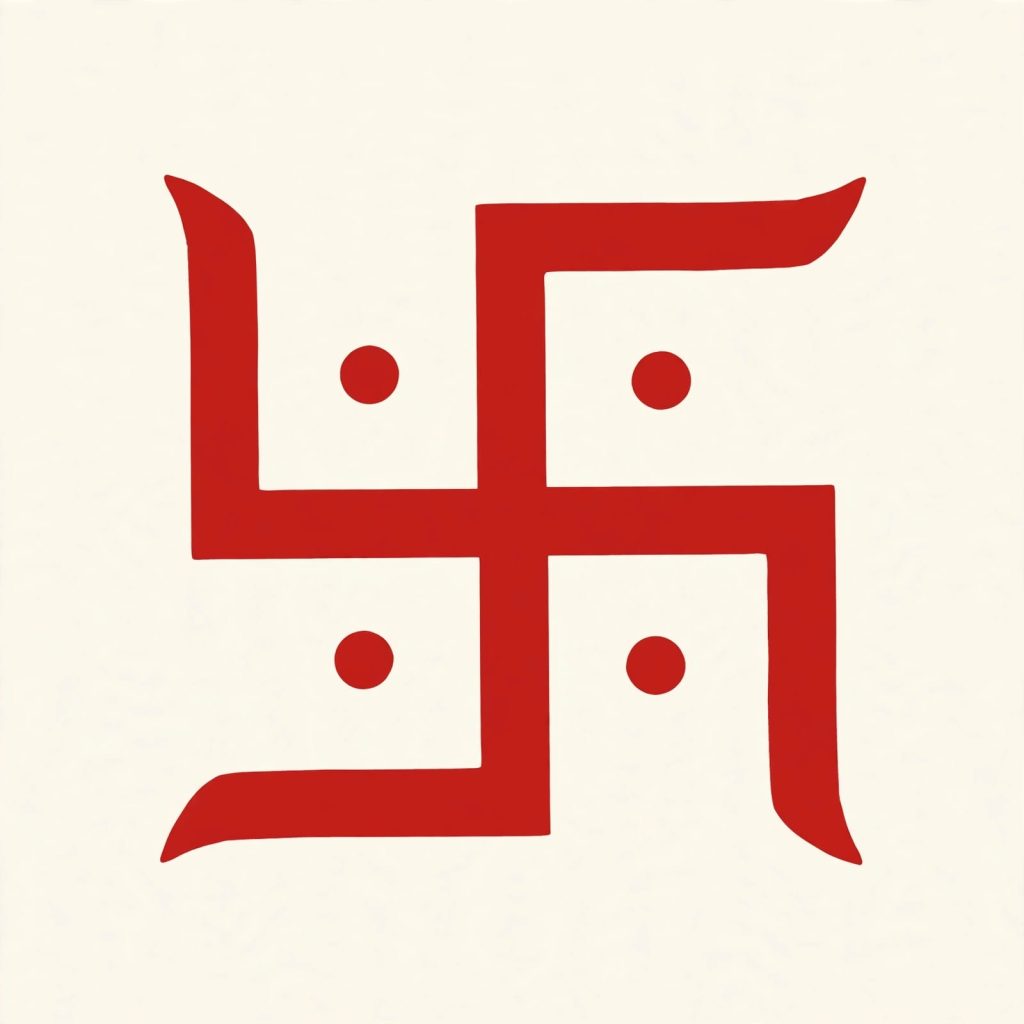
(4) Swastika as a Symbol of Hate
Unfortunately, there is a widespread conflation, particularly in Western countries, of the ancient, auspicious Hindu Swastika with the Nazi Hakenkreuz that creates confusion and misunderstanding in minds. Consequently, many critics and sceptics treat Swastika as a hate symbol in spite of the fact that the indigenous religions, namely Hinduism, Jainism and Buddhism, in Indian subcontinent treat their swastika as a pious symbol of well-being, auspiciousness and harmony as against the Nazi Hakenkreuz (or hooked cross) symbolizing racial supremacy and hatred. It is one of the most undesirable and tragic cases of cultural appropriation and linguistic misrepresentation in the modern history in that Nazi Germany appropriated the ancient Swastika symbol in the 1920s and made it the emblem of the National Socialist Party. Under its Dictator Hitler, the symbol became inextricably associated with Nazism, racial supremacy, antisemitism, the Holocaust and atrocities during the Second World War.
Notwithstanding this undesirable mix up, the historical and cultural distinction between Hindu Swastika and Nazi Hakenkreuz is markedly distinct and fundamental. The Indian Swastika is an ancient auspicious symbol, thousands of years old and deeply embedded in Hinduism, Buddhism and Jainism (with minor distinctions among them) that traditionally represent well-being, prosperity, auspiciousness and cosmic harmony. In contrast, the Nazi Hakenkreuz, despite its derivation from the similar ancient geometric motif, was appropriated to give an altogether entirely different ideological meaning symbolic to the racial superiority, hatred, and even genocide (of Jews). People in Western countries must learn this difference to avoid conflation of the two traditions as well as attribution of Nazi associations to the Hindu symbol.
Although, structurally, the two symbols are based on the same geometric motif viz. cross with four arms bent at right angles but with following commonly observed clear visual distinctions.
| Feature | Hindu Swatika | Nazi Hakenkreuz |
| Orientation | Upright, resting on a horizontal arm | Rotated 45°, standing diagonally |
| Arms | Often accompanied by four dots | Usually without dots |
| Visual | Red/vermilion, usually on white/gold background | Black on white circle, red background |
| Setting | Used standalone, In religious motifs | Nazi Germany, Hate groups |
| Message | Peace, auspiciousness and well-being | Racial supremacy and hatred |
Orientation of symbols is not sufficed and foolproof distinction because other Indian traditions viz. Jains and Buddhists swastikas also use differently oriented forms. The Nazi emblem is particularly distinguished with Indian traditions by its standardised diagonal presentation, purpose and political use. In the context of Etymology, the word Swastika is of Sanskrit origin derived from two root words: Su (meaning Good/Well) plus Asti (meaning Be/Existence) and suffix “Ka”. This literally translates to that which brings well-being, prosperity, and good fortune. This symbol has remained in use of the Indian traditions for the last several millennia. The Hindu Swastika drawn clockwise with four compulsory dots also represent four Vedas, the four directions and the four goals (Purusharthas) of the human life. To the best of this author’s knowledge, the symbol used by Adolf Hitler and the Nazi Germany was never called a “Swastika” in German, but strictly referred to as the Hakenkreuz or literally the “Hooked Cross”.
This author has also attempted to decode the reason behind the obtaining conflation or confusion about the western misconception perceiving Hindu Swastika as hate symbol. It appears the German Dictator Hitler consistently used the word Hakenkreuz (inspired from Christian monastic motifs) in his book Mein Kampf (1924) that he wrote while in jail. While translating it into English, James Murphy and co-translators mistakenly rendered it as “Swastika” in 1930s. This is how an Oriental terminology found a place in a European political emblem, linking the racial hate and atrocity of Nazis to the Indian heritage. Following active efforts by global Hindu/Jain/Buddhist organizations to educate international audience, some European interfaith councils and State Legislatures have now made formal amendments to their laws distinguishing two symbols.
To sum up and recapitulate, the Hindu Swastika is an ancient Sanskrit symbol of peace, harmony and prosperity while the Nazi emblem Hakenkreuz was (is) a politically weaponized symbol of racial supremacy and abuse. The misconception that the Swastika is inherently a symbol of hate arises from the tragic historical mistranslation that conflates an ancient Dharmic emblem of peace with the 20th-century Nazi Hakenkreuz (Hooked Cross). In modern age, any attempts in conflating the two is an injustice and insult to ancient Sanatana Dharmic (Hindu) civilization and culture. Hence the need for educating the world about this linguistic error and visual differences between Swastika and Hakenkreuz that would ensure the former, a sacred symbol of divine harmony, auspicious beginnings and the movement of life, is liberated from the dark legacy of 20th-century European (Nazi) fascism.
102 total views, 102 views today




No Comments
Leave a comment Cancel