



Book By Sanjeev Kumar
Sanjeev Kumar’s masterpiece “Sarve Bhavantu Sukhinah: Prosperity and Happiness for All” presents an inspiring narrative focused on human values and ethics such as kindness, integrity and fairness, along with social responsibility in a world increasingly driven by material living, success and achievement. Deriving its title from an ancient Indian prayer wishing health and happiness to all of humanity, the book reimagines progress not merely as personal career achievement, but as a collective development, empathy and service. Set in the rural backdrop of Shantigram, which as author rightly interpreted to have greater purity and consistency compared to any urban set up, the story illustrates how traditional ethical foundations and modern aspirations can seamlessly coexist to transform both individuals and community life.
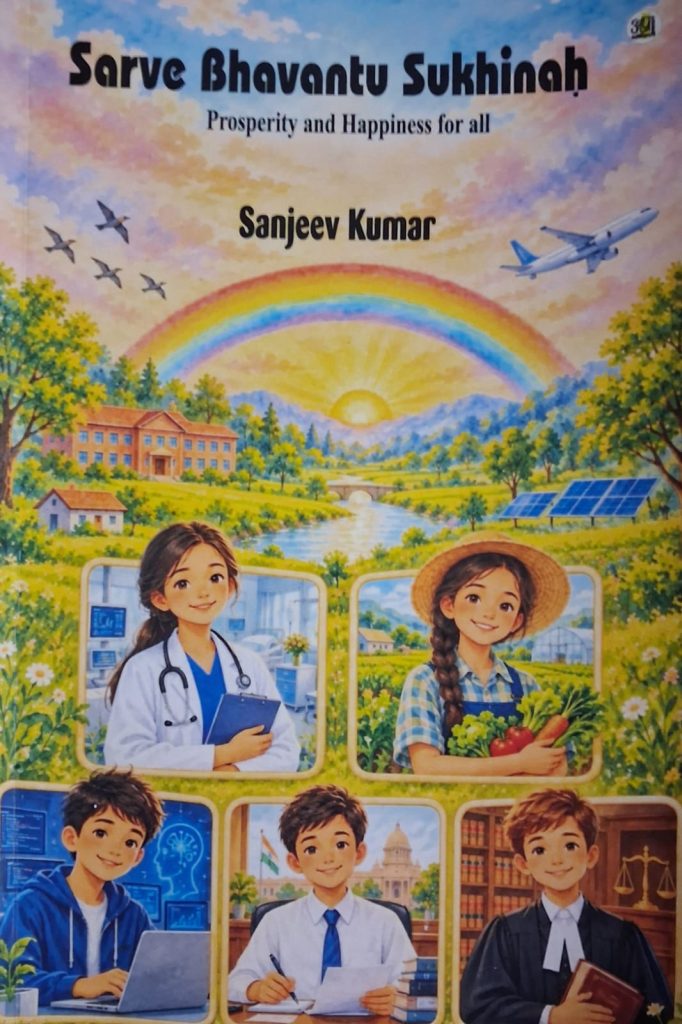
At the heart of the narrative is Vidya Mandir Inter College and its progressive Principal, Mrs. Pratibha Sharma, which embodies an educational model where learning extends far beyond academic curricula. The plot follows five young characters and mutual friends—Ashish, Simaran, Radhika, Alex and Ashraf, as they navigate their distinct career paths. Through their journeys into law, engineering, medicine, digital innovation, and public administration, the author illustrates that every professional avenue can serve as a catalyst for societal advancement when approached with foresight, integrity and social consciousness. Another notable point is that irrespective of the heights of success achieved by protagonists in the respective discipline, they retain their humility, grounded nature and unwavering resolve for ethical living.
A central highlight for student readers is the practical message regarding career choices and personal growth. The narrative demonstrates that a student’s potential is neither defined by their geographical origin nor by competitive entrance ranks. By exploring Ashish’s legal pursuits, Radhika’s medical journey, Simaran’s focus on agricultural innovation, Alex’s digital entrepreneurship and Ashraf’s public service, the narrative of text retains an underlying tone of self-discovery, resilience and application of knowledge to real-world challenges over blind competition. This reflects not only their steadfast commitment for individual progression combined with social service but also the values deeply ingrained within their persona from early days.
The book further weaves together timeless philosophical teachings—from Indian scripture to universal moral traditions and Rabindranath Tagore’s educational philosophy—to highlight the necessity of holistic development. It directly addresses the modern digital age, asserting that rapid technological advancements like artificial intelligence must remain firmly anchored in ethical judgment, human empathy, and inclusive welfare. In a short review like this, it is not feasible to capture and highlight all personal attributes of five protagonist friends besides their professional skills but I am tempted to mention Ashraf here because we not only shared profession (civil service career) but also inter alia a common passion for chess with somewhat similar achievements with a knack for foresight, patience and decision-making. This illustration is only to underline the fact that a true professional achiever very often has multifaced personality.
The practical outcome of the narrative occurs when the central characters return to their roots to establish the Sarve Bhavantu Sukhinah Trust. This initiative establishes multi-faceted community support hubs—focusing on career counselling, sports talent development, digital literacy and sustainable farming. By demonstrating how personal success can loop back to empower the underprivileged, the book offers students a concrete blueprint for active citizenship and community building. Ultimately, the narrative transcends a mere story of individual success, transforming into an inspiring anthem for social change and collective prosperity. Further, in doing so, the book also transforms personal triumphs into a shared legacy of hope and transformation.
The only reservation or scepticism about the idealism chosen by the author in the book about social cohesiveness, communal harmony, universal peace and progress is very briefly recorded here. From a socio-historical perspective, Indian society inter alia has a complex blend of community dynamics, educational patterns, institutional access and socioeconomic conditions. In many regions, lower urbanization and reliance on traditional religious seminaries (madrasas) make it even more complicated. The apparent reluctance of average citizens in that particular theological community to publicly challenge conservative clerical voices and handful radical elements only further derail efforts and voices of few progressive youth and reformists in the community advocating for larger civic integration.
In fact, there seems to be a global trend whereby while developing democracies like India face greater threats and challenges on account of this socio-communal divide, and consequential threats and challenges, even the developed and prosperous democracies of the West are increasingly under stress to cope with the increasing socio-communal disharmony. Nonetheless, I support the author’s optimism, spirit and contribution through his book to bridge obtaining divides – aligning universal human welfare (Sarve Bhavantu Sukhinah) with constitutional governance – by further continuous strengthening secular education, and encouraging internal reforms that prioritize shared civic duties over insular identity.
In today’s fast-paced educational climate—dominated by high-stakes testing, algorithm-driven learning, and intense specialization—Sanjeev Kumar’s book serves as a vital corrective. Modern education frequently risks reducing students to mere economic units trained solely for market utility. Sarve Bhavantu Sukhinah offers a refreshing counter-narrative, reminding educators and learners that technical competence without moral and ethical grounding is incomplete. By embedding emerging technologies like AI within an ethical, human-centric framework, the book provides a balanced paradigm for 21st-century schooling: one where technological innovation and economic progress are continually aligned with empathy, social justice and holistic human well-being.
66 total views, 66 views today




No Comments
Leave a comment Cancel