



The ancient Hindu festival Chhath Puja is indeed one of the most remarkable ancient Hindu traditions of nature-centred worship in various parts of India. Unlike many other Hindu festivals, its principal object of worship is not an idol at home or a temple deity, but the visible Sun, accompanied by reverence for earth, water, vegetation and the natural cycles that sustaining life on planet. The puja also has interesting linkages with the Vedic traditions, the Ramayana, the Mahabharata and regional folk tales and beliefs.
Tradition & Significance
Chhath Puja is primarily dedicated to Surya (the Sun God) and Chhathi Maiya (also remembered as Shashthi Devi). People celebrated it to express gratitude to the Sun for sustaining life on Earth and to seek divine blessings for health, longevity, prosperity, fertility and the well-being of children and family at large. The festival has traditionally been most popular in Bihar, Jharkhand, eastern Uttar Pradesh (more so in the Purvanchal region) and adjoining parts of Nepal. Though it is especially significant and auspicious among the Bhojpuri, Maithili and Magahi-speaking communities but it increasingly getting popularity among other people and parts.
Although traditionally linked with women, Chhath Puja is not a gender-specific festival. Both men and women observe its rigorous fasts and rituals. Over the years, it has spread to Delhi, Mumbai, Kolkata and practically every major Indian city, largely through migration of people from Bihar and eastern Uttar Pradesh. For instance, reportedly the Delhi government has arranged a total of 1,482 ghats across 996 locations, which include 29 ghats along the Yamuna River besides the major 11 km development on the Munak canal. Indian diaspora communities also celebrate it in several countries, including Mauritius, Fiji, Trinidad and Tobago and elsewhere.
The central theme of Chhath is gratitude towards the Sun, the ultimate known and visible source of energy, light and life on Earth. In Hindu cosmological understanding, Surya is not merely a celestial object but a manifestation of divine energy, sustaining all living beings. Chhathi Maiya, popular term associated with Shashthi Devi, is particularly revered as the protector of children, and blessing progeny and family welfare. Another special distinctive feature is that devotees offer prayers to both the setting and the rising Sun, contrary to usual tradition of reverence for the rising sun. This represents gratitude not merely for the beginning of life and prosperity but also for the completion of a cycle. The rigorous fasting, self-restraint, cleanliness and discipline further make it an occasion for spiritual purification, thanksgiving and collective devotion.
Nature Worship
It can indeed be classified as nature worship with an apt description of Chhath Puja for the following objects and elements associated with its rituals:
- Sun: The principal object of worship, representing light, energy and life.
- Earth: The offerings are agricultural produce, fruits and other gifts of the soil.
- Water: Rivers, ponds and other water bodies are integral to the worship.
- Fire: Earthen lamps illuminate the surroundings during the evening rituals.
- Vegetation: Sugarcane, bamboo baskets, leaves and seasonal produce form essential components.
- Human life: The prayers seek health, fertility, longevity and the continuity of generations.
There is something particularly interesting and worth mentioning here. Unlike many other Hindu festivals, Chhath Puja does not require an elaborate idol, temple or even a priest. The devotees directly address the visible Sun, setting and rising, while standing in a natural water body such as river, lake, pond, etc. The offerings comprise largely of locally available agricultural produce such as sugarcane (Ganna), rice and paddy, wheat, sorghum, raw turmeric, raw ginger, sweet potato, radish, many seasonal fruits, nuts and betel leaves. The festival thus reflects an ancient understanding of the interdependence of natural products and human existence. It is not simply worship of nature as an external entity; it is an expression of gratitude towards the natural order of which human beings themselves are an integral part. This can be easily interpreted as a living expression of ecological consciousness embedded in Hindu religious tradition.
Mythology & Legends
In fact, there is no single universally accepted account of the origin of Chhath Puja. Several mythological or legendary regional traditions suggest its association with Surya and Chhathi Maiya. These narratives should be recognized as socio-cultural and/or religious traditions and folklore because it is difficult to establish any credible historical accounts.
1. The legend of King Priyavrat and Shashthi Devi
One of the more popular and interesting tales is associated with King Priyavrat and his queen Malini, as recounted in traditions associated with the Brahmavaivarta Purana. According to this legend, the king and queen were childless. They performed a Putrakameshti Yajna, seeking the blessing of a child as advised by their Rajguru. Consequently, the queen became pregnant, but unfortunately the baby was stillborn. Overwhelmed with grief, she approached a river with suicidal thinking, where she encountered a divine woman who revealed herself as Devasena or Shashthi Devi. She advised the grieving queen to worship Surya and Her for the blessing and protection of children. The queen returned to palace implementing her instructions and was eventually blessed with a normal and healthy child. Following this episode, Shashthi Devi came to be revered as Chhathi Maiya, as the divine protector of children and the granter of progeny. This narrative provides a significant mythological or legendary explanation for the association of Chhath with fertility, motherhood and the welfare of children.
2. The Ramayana connection
Another popular tradition links Chhath Puja with God Rama and Goddess Sita. According to this account, after returning victorious to Ayodhya from Lanka, Rama and Sita observed a steady fast and performed Surya worship. A regional tradition specifically associates Sita with the observance of Chhath following their return. In Munger, Bihar, there is a local belief that Sita performed the Chhath Vrat (fast) at a particular place, now associated with Sita Charan Mandir. The observance of puja is at times interpreted as an act of thanksgiving to Surya following their return from exile and victory over Ravana. Some traditions also associate it with the purification and expiation rituals following the great war.
3. The Mahabharata connection
The Epic Mahabharata also offers two particularly interesting associations. In first case, Karna, born to Queen Kunti through blessings of Surya, was an ardent devotee of his divine father. According to popular tradition, he would regularly stand in water and offer prayers and Arghya to the rising Sun. Besides, Karna is also remembered for his extraordinary generosity and distribution of gifts to the needy or every seeker. Accordingly, the worship of Surya is regarded as one of the mythological antecedents of Chhath in some areas. According to another legend associated with Queen Draupadi and five Pandavas, they faced numerous hardships during their exile. Therefore, Draupadi approached Sage Dhaumya for guidance on one occasion. The sage advised her to worship Surya and observe a fast. Draupadi followed his instructions, and the Pandavas were subsequently relieved of their hardships, including eventual recovery of their kingdom.
Associated Karmakanda (Rituals)
Chhath Puja is originally observed twice annually as Kartik Chhath and Chaiti Chhath, the former in October-November and the latter in March-April. However, Kartik Chhath is more popular and widely observed six days after Diwali in most parts. The main observance extends over four days, beginning with Chaturthi and culminating on Saptami of the Shukla Paksha of the lunar month.
The four days have distinct names and rituals.
Day 1: Nahay-Khay (Bathing & Food) – The festival begins with ritual bathing in a river, pond or other water body. The house and particularly the kitchen are properly cleaned. The person observing the fast, traditionally called the Vrati, takes a simple and pure meal, usually comprising of rice, chana dal and pumpkin vegetable. The food is prepared with special attention to cleanliness and purity. In many households, traditional cooking utensils and even a separate cooking arrangement are maintained for the occasion.
Day 2: Kharna or Lohanda – The person observes vrat (a fast) throughout the day and breaks it after sunset, following prayers. The principal offerings include rice kheer, generally prepared with jaggery, and chapatis or rotis. Fruits may also be offered. After the evening worship, the Prasad is distributed among family members and others. Following this meal, the devotee begins a rigorous fast lasting approximately 36 hours, for many without even drinking water.
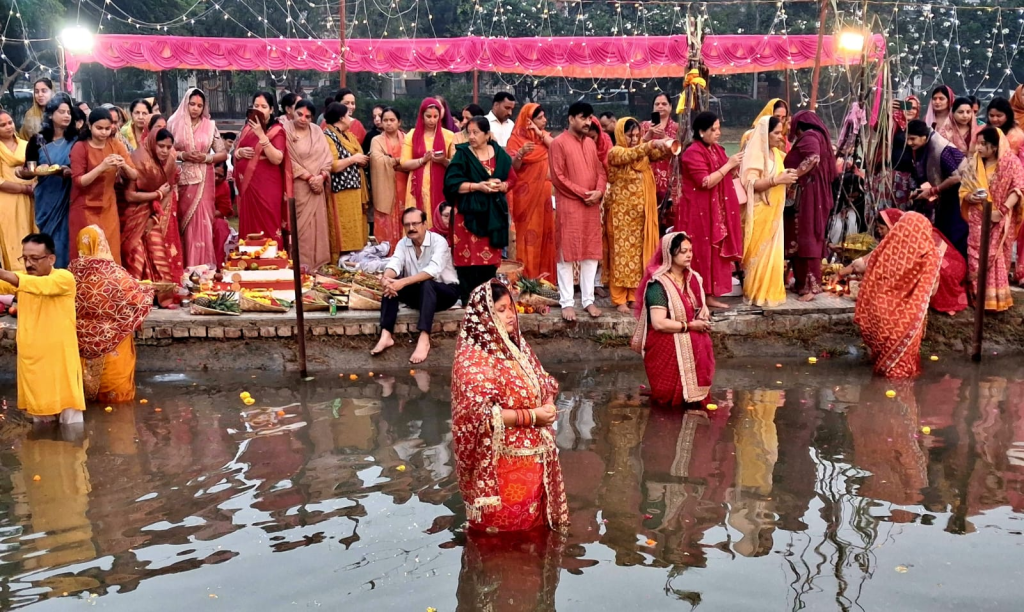
Day 3: Sandhya Arghya – This is the most visually spectacular part of the festival as devotees gather at riverbanks, ponds and other designated water bodies. The Vrati, accompanied by family members, enters the water, sometimes standing waist-deep, and offers Arghya to the setting Sun. The offerings are arranged in bamboo baskets called Soop and Daura, and generally include Thekua, a traditional sweet prepared from wheat flour and jaggery; Sugarcane; Bananas, coconuts and seasonal fruits; Sweet potatoes and other agricultural produce; Rice-based and other traditional Prasad/preparations; Earthen lamps (Diyas); Milk and water. The aforesaid substances are offered to the Sun as part of the Arghya ritual. In many regions, the evening is also associated with Kosi Bharna, in which sugarcane stalks are arranged to form a small canopy, decorated with earthen lamps and offerings.
Day 4: Usha Arghya – Devotees return to the riverbanks or water bodies before sunrise. They again stand in water and offer Arghya, this time to the rising Sun, popularly called Usha Arghya or Bhor ka Arghya. After the prayers, the Vrati completes the fast through a ritual called Parana. Prasad is distributed among family members, neighbours and the wider community indicating conclusion of fast and festivity.
Dress, food and other customs
Traditional regional attire is an important part of the festival. Women observing the fast generally wear clean, so often new sarees, mostly in yellow, red, orange or other auspicious colours. Men observing the fast may wear dhoti and kurta by choice. The emphasis is on observance of simplicity, cleanliness and ritual purity rather than elaborate ornamentation.
Thekua deserves a special mention in this context as perhaps the most recognisable culinary symbol of Chhath Puja. Prepared from wheat flour, jaggery and ghee, it is traditionally fried and offered as Prasad. Other offerings include rice kheer, bananas, coconuts, sugarcane, seasonal fruits and other agricultural products.
Bamboo baskets and winnowing trays are extensively used. Earthen lamps, sugarcane stalks, flowers and traditional folk songs create the characteristic atmosphere of the festival and viewers attraction. The songs, particularly in Bhojpuri, Maithili and Magahi, are usually dedicated to Surya, Chhathi Maiya, motherhood, family relationships and the blessings of nature.
Although the essential rituals remain broadly similar, the regional variations in festive celebrations do exist. For instance, in Bihar and eastern Uttar Pradesh, the festival is particularly elaborate, with large gatherings at the ghats of the Ganga, Gandak, Saryu and other rivers. In Jharkhand, devotees observe similar traditions around local rivers, ponds and reservoirs. In Nepal’s Terai region, Chhath is widely celebrated among the Madhesi communities too. In metropolitan cities like Delhi and larger cities like Lucknow, where access to rivers may be limited, temporary ponds and specially constructed water tanks are frequently used. The four-day rituals, however, remain the common thread connecting these various regional practices.
Other Worth Mentioning Facts
A few additional aspects that make Chhath particularly auspicious and interesting from a sociocultural perspective are as follows.
- It has relatively an egalitarian character with observance across the caste and economic boundaries. There is generally no requirement for a priest and devotees directly offers prayers to Surya and Chhathi Maiya, making the relationship between the seeker and the divine remarkably direct.
- Another characteristic feature is community participation. Even people who do not observe the fast participate in cleaning riverbanks, preparing the ghats, arranging offerings, helping devotees and attending puja.
- The festival has significant ecological value as nature worship. The festival draws attention towards the importance of clean rivers, ponds and other water bodies. Its traditional use of locally available fruits, agricultural produce, bamboo baskets and earthen lamps also reflects a close relationship with the natural environment.
- Particularly appreciable philosophical aspect is that Chhath Puja attaches equal reverence to the setting Sun and the rising Sun. It acknowledges that even the declining phase of a natural cycle deserves gratitude and respect with acceptance, continuity and renewal.
Postlude
Chhath Puja is much more than a religious festival or an occasion for fasting. It represents an ancient cultural consciousness in which human existence is understood as inseparable from the forces of nature. Its reverence for the Sun, water, earth and agricultural produce, combined with its emphasis on austerity, purity, gratitude and community participation, makes it a distinctive expression of Hindu civilisational traditions such as Vasudhaiva Kutumbakam and Sarve Bhavantu Sukhinah. Perhaps its most profound message is that humanity must acknowledge its dependence upon nature, respect the rhythms of creation and remain grateful for the elements that sustain life.
Image: Jaipal Singh
228 total views, 5 views today




No Comments
Leave a comment Cancel